The soleus muscle is a powerful, flat muscle located in the posterior (back) compartment of the lower leg. It sits deep beneath the larger and more visible gastrocnemius muscle. Together, they form the triceps surae, which is responsible for plantarflexion of the ankle the movement of pointing the foot downward.
Unlike muscles designed for explosive movement, the soleus is built for endurance. It works continuously during standing, walking, and maintaining posture. Despite comprising only about 1% of total body mass, research shows it becomes the dominant energy-consuming muscle during low-intensity seated activity.
Most people can name their biceps. Few can identify the soleus yet it may be one of the most important muscles for modern health.
The soleus is located in the back of the lower leg, deep to the gastrocnemius. It originates from the posterior surfaces of the tibia and fibula and joins the calcaneal tendon (Achilles tendon), which inserts into the heel bone.
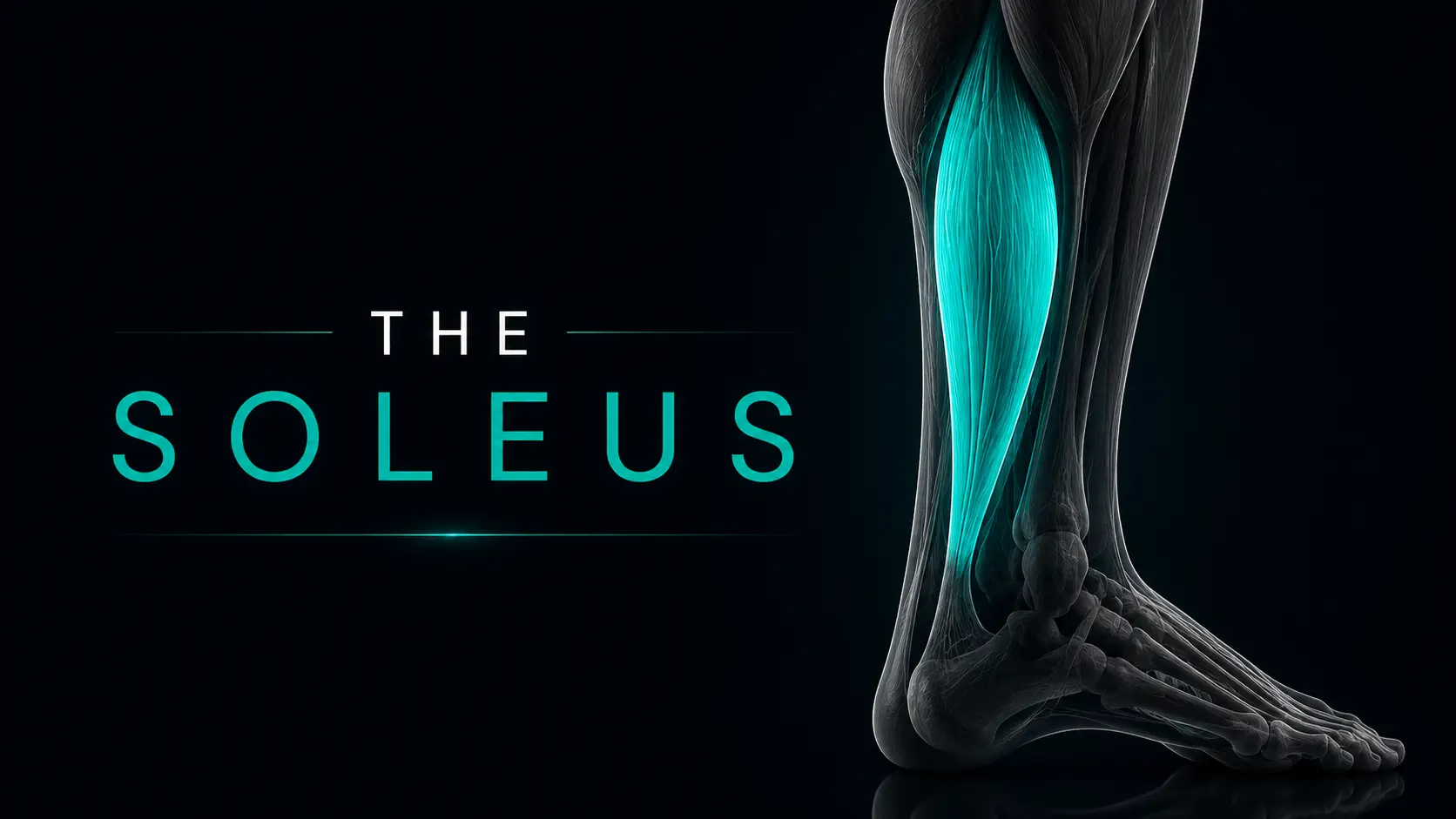
The soleus lies in close proximity to the deep veins of the calf. When the soleus contracts, it compresses these veins, assisting in venous return, the movement of blood from the lower legs back toward the heart.
The soleus is composed of approximately 70 to 80 percent slow-twitch Type I muscle fibres one of the highest proportions of any skeletal muscle in the human body.
| Property | Value | Significance |
|---|---|---|
| Body mass | ~1% | Small in size, disproportionate importance during sitting |
| Slow-twitch fibres | 70-80% | Built for endurance, not power |
| Fatigue resistance | Very high | Can work for hours without tiring |
| Oxidative capacity | Extraordinary | Uses circulating fuels efficiently |
Slow-twitch fibres are fatigue-resistant and oxidative, meaning they use oxygen efficiently and can sustain activity for long periods. Fast-twitch muscles (like the gastrocnemius) are designed for bursts of power but fatigue quickly. The soleus is the opposite: low power output, extremely high endurance.
The term "second heart" is not marketing. It is a physiological description used in published scientific literature.
Here is why: The heart pumps blood outward to the body. But returning blood from the lower legs to the heart faces a challenge gravity. To overcome this, the body relies on the skeletal muscle pump. When muscles contract, they compress nearby veins, pushing blood upward.
The soleus plays a major role in supporting venous return from the lower limbs. This is why researchers call it a peripheral heart.
Limitations of the nickname: The soleus does not replace the heart. It supports circulation but does not drive the entire cardiovascular system. The term is descriptive, not literal.
Venous return is the movement of blood from the extremities back to the heart. Unlike arteries, veins rely on external forces one of which is muscle contraction.
When the soleus contracts, it compresses the deep veins of the calf. One-way venous valves ensure that blood flows upward toward the heart. This is called the calf pump.
During prolonged sitting, calf pump activity decreases. Blood can pool in the lower legs, and venous return slows. Activating the soleus periodically during sitting supports this natural pumping mechanism.
Bending the knees to roughly 90° for hours strips away most of the soleus's normal workload the low-level, continuous contractions it performs all day while you're upright simply stop happening.
Effects on blood flow: With reduced soleus activity, the calf pump slows. Venous return decreases. Blood flow in the lower legs declines.
Desk worker relevance: at 8-10 hours of daily sitting, this isn't an occasional lapse it's the default state for a muscle built to run continuously.
See the full breakdown of what happens when it goes inactive →
Modern work culture has fundamentally changed how humans spend their days. In 1970, approximately 20% of jobs were sedentary. Today, over 80% of jobs involve prolonged sitting. Our workplaces evolved faster than our bodies could adapt.
The human body was designed for movement. When we sit for 8-10 hours daily, entire physiological systems operate differently. The soleus, designed as an endurance muscle for upright activity, becomes largely inactive. This isn't a design flaw it's a mismatch between modern life and human evolution.
This is why this muscle suddenly matters. Not because it's new, but because the way we live has changed, and the soleus sits at the intersection of that change.
Yes and that matters. The soleus can be activated during sitting through seated plantarflexion.
How it works: While seated with feet flat on the floor, press your forefoot down while keeping your heels in contact with the ground. This lifts the heels slightly and engages the soleus. You can do this without changing posture, without standing, and without interrupting work.
This movement is sometimes called a "soleus push-up". It is low-intensity, fatigue-resistant, and can be performed repeatedly throughout the day.
A small movement during sitting may matter more than most people realise not because it replaces exercise, but because it addresses the hours that exercise doesn't.
How to perform it:
- Sit upright with feet flat on the floor
- Keep your toes in contact with the ground
- Slowly raise your heels as high as comfortable
- Lower back down with control
- Repeat rhythmically
Common mistakes: Using momentum rather than control, lifting the entire foot, tensing the thighs, bouncing, or rushing the movement.
Several independent institutions have investigated the soleus muscle and its role in seated physiology.
| Study | Institution | Finding | Year |
|---|---|---|---|
| Hamilton et al. | University of Houston | 52% reduction in post-meal glucose excursion during seated soleus activation | 2022 |
| Elek et al. | Sports (Basel) | 32% reduction in prediabetic indicators with soleus activation | 2025 |
| Houghton et al. | Mayo Clinic / Blood Journal | Reduced soleus activity associated with 2x higher health risk | 2021 |
| Niccolini et al. | Frontiers in Physiology | Upward flow increases 4x during soleus contraction | 2020 |
2HEART did not conduct these studies. We cite them because they explore the same problem we are working on: what happens to the human body during prolonged sitting, and what role the soleus may play.
Diabetes and metabolic health: The soleus's ability to draw energy from circulating fuels has attracted research attention. Studies have explored whether activating the soleus during sitting influences metabolic markers. Read more about sitting and blood sugar →
Venous insufficiency and circulation: For people with poor venous return, calf muscle function matters. Seated soleus activation may support circulation as part of a broader movement strategy. Read more about heavy legs → | Read more about leg swelling →
Older adults and mobility limitations: The soleus push-up is low-impact and can be performed from a chair.
Desk worker health: This guide is especially relevant for people who spend 8+ hours seated daily. Resources for desk workers →
A deep calf muscle located beneath the gastrocnemius. Composed primarily of slow-twitch muscle fibres, it plays an important role in standing, walking, and supporting circulation. View glossary definition →
Researchers call it the second heart because soleus contractions help pump blood upward from the lower legs toward the heart, working against gravity. View glossary definition →
Its activity drops off sharply once the knee holds a seated angle for a while, since the muscle is built for the ongoing low-level work of standing and walking, not stillness.
Yes. Through seated plantarflexion pressing the forefoot down while keeping the heel in contact with the ground the soleus can be activated without changing posture.
A seated heel-raise movement that specifically targets the soleus muscle. It involves sitting upright, keeping the toes on the ground, and lifting the heels slowly.
Approximately 1% of total body mass. Yet during low-intensity seated activity, research shows it becomes the dominant energy-consuming muscle in the body.
70-80% slow-twitch Type I muscle fibres one of the highest proportions of any skeletal muscle in the human body.
A wellness category introduced by 2HEART: the practice of activating and tracking the soleus muscle during seated hours to support everyday body movement and responsiveness.
Anyone who spends extended hours sitting desk workers, remote professionals, frequent travellers, and anyone curious about seated physiology.
SHB stands for Soleus Heart Beat. It counts the number of soleus activations during a 2HEART session. A higher SHB means your second heart was active today. View glossary definition →
No. SHB is a wellness and movement tracking metric. It is not a clinical diagnostic tool and does not measure any medical parameter.
2HEART is built on peer-reviewed research from independent institutions including the University of Houston, Mayo Clinic, and others. See the full research index at 2heart.in/research.
Not yet. 2HEART is in development and prototyping. Clinical validation studies are planned for future stages.
Fitness trackers passively observe steps and heart rate. 2HEART actively engages the soleus and measures the body's response during sitting hours.
- Hamilton MT, Hamilton DG, Zderic TW. A potent physiological method to magnify and sustain soleus oxidative metabolism improves glucose and lipid regulation. iScience. 2022. View publication →
- Elek D, Tóth M, Sonkodi B et al. The Efficacy of Soleus Push-Up in Individuals with Prediabetes: A Pilot Study. Sports (Basel). 2025. View publication →
- Houghton DE, Ashrani A, Liedl D et al. Reduced calf muscle pump function is a risk factor for venous thromboembolism. Blood Journal. 2021. View publication →
- Niccolini G et al. Possible Assessment of Calf Venous Pump Efficiency. Frontiers in Physiology. 2020. View publication →
- Recek. Calf pump activity influencing venous hemodynamics. Int J Angiol. 2013. View publication →
Be among the first to explore Soleus Health
Join early access. No spam. One email when it matters.