2HEART Soleus Health Science Research News Founder About Join Early Access
Introducing Soleus Health

Understanding the Hours Between Exercise

Soleus Health is a framework for understanding how the soleus muscle, your body's second heart, supports circulation, metabolism and energy during prolonged sitting.

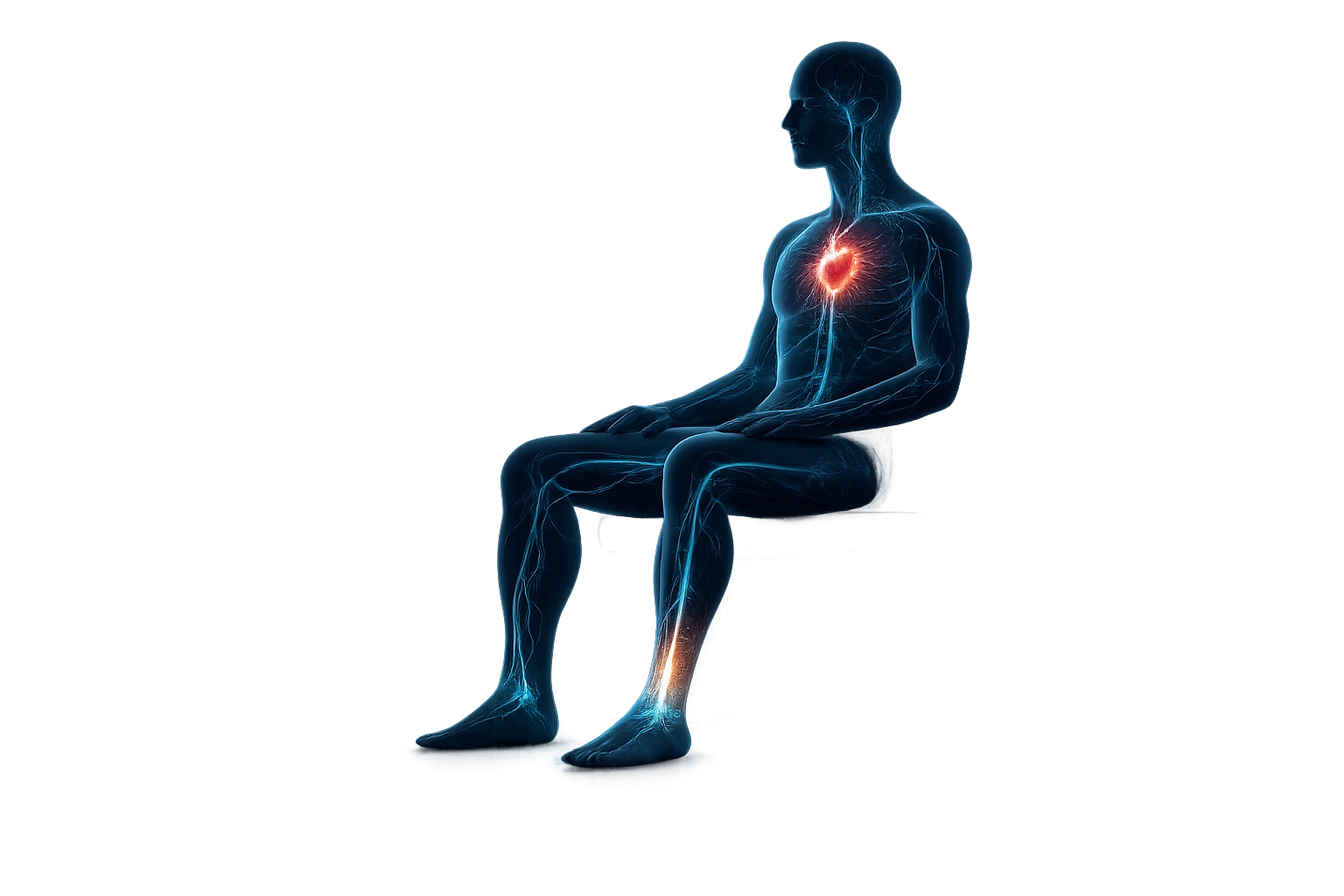
Semi-transparent seated person showing the heart, blood vessels and soleus muscle
What Is Soleus Health

For decades, health meant
three things.

We were taught that if we ate well, exercised regularly, and slept enough we were doing everything right.

Eat well. Exercise regularly. Sleep enough.

These three habits have helped millions of people live healthier lives. And yet.

01
Why do millions of people still feel tired by 3 PM?
Even after a full night's sleep. Even after coffee.
02
Why do legs feel heavy after a day at the office?
Not from exercise. From sitting still.
03
Why does concentration disappear by afternoon?
The work didn't change. The body did.
The answer nobody was tracking

Modern life introduced a challenge that health science had no category for. Something we did for 8 hours a day, every day, that nobody was measuring.

24 Hours every day Your body never stops responding.
1 Hour of exercise Only part of the story.
8+ Hours sitting Where Soleus Health begins.
Steps ✓ Tracked
Heart Rate ✓ Tracked
Sleep ✓ Tracked
Calories ✓ Tracked
Blood Glucose ✓ Tracked
What happens while sitting ✗ Not tracked
The Missing Category
Soleus Health

At 2HEART, we use the term Soleus Health to describe an emerging way of understanding how the soleus muscle, one of the body's most overlooked muscles, supports circulation, metabolism, and energy during the hours we spend seated.

It is not a medical diagnosis.
It is not a recognised medical specialty.
It is a framework for understanding one of the biggest blind spots in modern health.
1
Overlooked Muscle
2HEART is being developed around this emerging science.
?
Still Being Studied
The science is evolving. View all research →
?
A Question
What happens inside your body while you sit?
How we arrived here

The Path to Soleus Health

Ancient
Healthy Life
✓ Foundation
Always
Eat Well
✓ Known
Always
Exercise
✓ Known
Always
Sleep
✓ Known
Modern
Modern Sitting
⚡ The Problem
Now
Missing Piece
↗ Discovered
2HEART
Soleus Health
→ The Answer
We Measure Almost Everything

Except what happens while we sit.

Steps
8,342
Tracked
Heart Rate
72 bpm
Tracked
Sleep
7.2 hrs
Tracked
Calories
2,140
Tracked
Soleus Health
Not Tracked

This alone explains why 2HEART exists.

Why Does Soleus Health Matter?

Why Does Soleus Health Matter?

For almost all of human history, movement wasn't exercise. It was simply life.

We walked. We climbed. We carried. We stood.

Movement happened naturally throughout the day.

Today, life has changed.

📍 Technology has replaced movement with convenience.
📍 Our work requires concentration more than motion.
📍 Transportation has replaced walking.
📍 Screens have replaced movement.

Our biology, however, has not changed nearly as quickly.

Many of us still exercise. But we also spend most of our waking hours sitting.

That simple shift has created an important scientific question.

What happens inside the body during prolonged sitting?

These experiences can have many causes.
😴Poor sleep
🥗Nutrition
Stress
🩺Underlying medical conditions

Researchers are now increasingly exploring another important contributor.

Prolonged sitting.

Soleus Health is about understanding those hours.
Not replacing exercise. Completing the picture.
2,000 Hours

Nearly three months every year.
In a chair.

That's 83 full days. Every year. Before 2HEART, no device existed for those hours.

2,000
Hours every year the average office worker spends seated
83 Full Days
3 Months in a Chair
8+ Hours Daily
Your Year Months spent sitting highlighted
Jan
Feb
Mar
Apr
May
Jun
Jul
Aug
Sep
Oct
Nov
Dec
Meet Your Second Heart

Your body has two hearts. Most people only know one.

Deep inside your calf lies a remarkable muscle called the soleus.

Designed for endurance, not for sprinting or jumping
Contracts rhythmically every time you walk
Helps move blood from your legs back toward your heart
Often called the body's "second heart"

Not because it is another anatomical heart.
But because it helps perform one of the body's most important supporting functions.

First Heart

Pumps blood from your heart to your body
Beats continuously
Everyone knows it

Second Heart (Soleus)

Helps move blood from your legs back toward your heart
Works through regular movement
Most people have never heard of it

When you're engaged in Active Movement...

Both are working together.

When you remain seated for long periods...

Your heart continues pumping.
Your soleus becomes far less active than it is during normal walking.

Active Movement

Both hearts working together

Sitting

Second heart becomes less active

That difference is one reason researchers have become increasingly interested in prolonged sitting.

Why Sitting Changed Everything

Why Sitting Changed Everything

📍 Exercise has never been more popular.
📍 Yet sitting has never been more common.
📍 This is one of the greatest paradoxes of modern health.
📍 One hour at the gym cannot change the reality that many people remain seated for the next eight hours.

Walking is one of the healthiest things you can do. → Keep walking.

Exercise is essential. → Keep exercising.

Soleus Health is not about replacing either.
It is about understanding what happens between them.

Because health is influenced not only by how much we move...

But also by what happens during the hours when we don't.

8
average hours seated per day
30 min of exercise
vs 8 hours of sitting
Every health device ever built was designed for the hours you are already active. Nobody built anything for the hours you are not.
Soleus Health In Everyday Life

Soleus Health is not about elite athletes.

It is about everyday life.

People who sit. People who work. People who commute. People who spend much of their day in a chair.

Researchers continue to explore how the soleus may influence several important aspects of health.

Blood Sugar

Understanding how soleus activity may influence the body's response to glucose after meals.

Circulation

Understanding how the soleus supports healthy blood flow from the lower legs during regular movement.

Energy

Understanding how prolonged sitting and reduced muscle activity may contribute to fatigue and reduced alertness.

Workplace Health

Understanding how healthier movement habits can become part of modern working life.

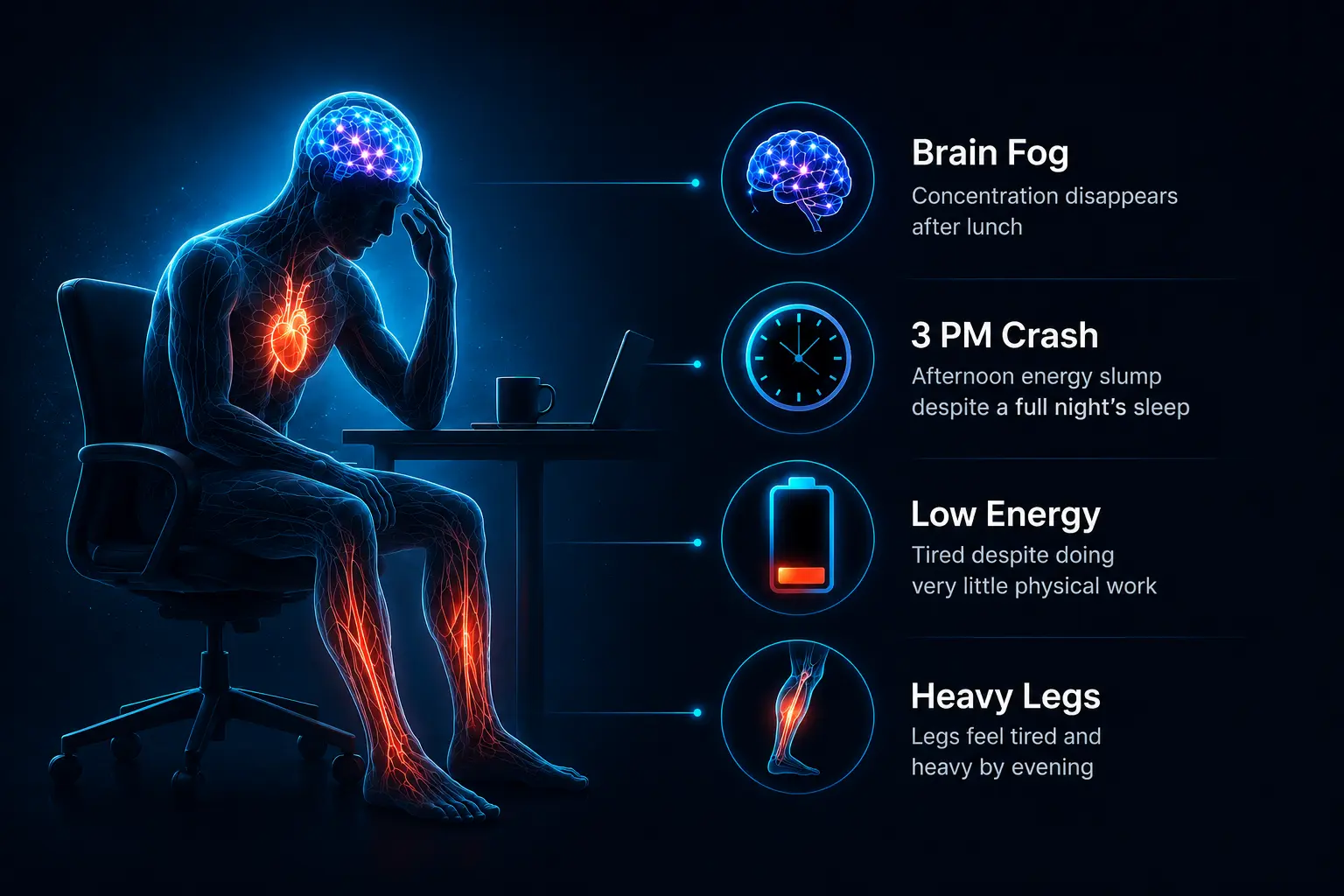
Do any of these sound familiar?

Your body might be trying to tell you something.

Body symptoms illustration showing brain fog, 3 PM crash, low energy, and heavy legs
Why Nobody Talks About This

Why has the soleus been overlooked for so long?

If the soleus is so important...

Why have most people never heard of it?

The answer is surprisingly simple.

Medicine
Disease
·
Fitness
Exercise
·
Wearables
Wrist
·
Soleus
Missing
Hours Between Exercise
Until now
Healthcare focused on diagnosing disease
Fitness focused on workouts
Wearables focused on the wrist
Very little attention given to what happens inside muscles during prolonged sitting
That is beginning to change
Researchers are paying greater attention to sedentary physiology
Sensing technology now makes it practical to study physiology during everyday life
Understanding the hours between exercise may become just as important as measuring the exercise itself
Common Myths

What people get wrong about sitting.

One workout cancels out a day of sitting.Click
Exercise remains one of the best things you can do for your health. It does not remove the importance of reducing prolonged sitting throughout the day.
Standing = MovementClick
Standing and movement are not the same. Regular movement remains important.
The soleus only matters to athletes.Click
The soleus works every day during ordinary walking, making it important for almost everyone.
This only matters later in life.Click
Modern sedentary lifestyles affect students, professionals, parents and older adults alike.
The Future Of Soleus Health

Where Soleus Health is headed.

For decades, health has focused on helping people move more.

The next decade may also focus on helping people understand the hours they don't move.

Researchers continue to explore how prolonged sitting influences circulation, metabolism and energy.

New technologies are emerging to help people better understand what happens inside their bodies throughout the working day.

Just as wearable technology changed how we think about sleep, activity and recovery...
Soleus Health may change how we think about sitting.

Yesterday
Exercise
Today
Wearables
Tomorrow
Soleus Health
The Science Behind Soleus Health

What independent science found.

Peer-reviewed research from the University of Houston, Mayo Clinic, and other institutions has explored the role of the soleus muscle in seated physiology.

A Living Resource

This page grows with the science.

Soleus Health is an emerging area of scientific interest.

This page is designed to grow alongside the science.

As new research is published, we will continue to:

📍 Review the evidence
📍 Explain new discoveries
📍 Challenge outdated assumptions
📍 Translate complex science into practical knowledge

Because the future of health is not only about how we eat.
Or how we exercise.
Or how we sleep.
It is also about understanding what happens during the hours between exercise.

2022Hamilton Study✓ Landmark
20242HEART Founded✓ Born
2025Soleus Health✓ Category
2026Clinical Studies⚡ In Progress
2027+More Research↗ Growing
Why 2HEART Exists

Research → Technology → Understanding.

We believe people deserve to understand what happens inside their bodies during the hours they spend sitting.

That belief inspired 2HEART.

We are building technology that combines guided soleus movement with physiological sensing to help people better understand how their bodies respond during prolonged sitting.

Our ambition is not simply to build a device.

It is to help people understand a part of health that has been hiding in plain sight.

To make Soleus Health understandable.
Measurable.
Practical.
And part of everyday life.

Research Technology Measurement Understanding Better Decisions
2HEART
Making Soleus Health understandable, measurable, and part of everyday life.
Frequently Asked Questions

Answers to common questions about Soleus Health.

The soleus is often called the body's "second heart" because of its important role in circulation. Unlike your actual heart, which pumps blood from your chest to the rest of your body, the soleus acts as a supporting pump that helps move blood back from your legs toward your heart. Every time you walk or move your feet, the soleus contracts rhythmically, compressing veins in your calf to push blood upward against gravity. When you sit for long periods, your soleus becomes less active, and this natural "pumping" action slows down. Learn more about the second heart →
No. Exercise is one of the best things you can do for your health, but it does not "cancel out" the effects of prolonged sitting. Think of it this way: eating one healthy meal doesn't undo an entire week of poor nutrition. Similarly, one hour at the gym doesn't completely reverse eight hours of sedentary behaviour. Researchers now recommend both regular exercise and reducing prolonged sitting throughout the day. They are complementary, not interchangeable. Read more about sitting and exercise →
Heavy legs after prolonged sitting are often related to reduced circulation. When you sit for extended periods, your soleus muscle becomes far less active than it is during walking. This means less of the natural "pumping" action that helps move blood from your legs back toward your heart. Blood can pool in the lower legs, leading to a feeling of heaviness, fatigue or discomfort. This is one of the reasons researchers are increasingly interested in understanding what happens inside the body during prolonged sitting. Learn about heavy legs and circulation →
Post-lunch sleepiness, often called the "afternoon slump," can have several causes: what you ate (large meals, high-carbohydrate foods), sleep quality the night before, and natural circadian rhythms. Researchers are also exploring another important factor: prolonged sitting. When you remain seated for long periods, your body's natural movement patterns change. Reduced muscle activity, particularly in muscles like the soleus, may influence how your body processes glucose and manages energy throughout the day. Explore Soleus Health and energy →
No. Soleus Health is not a medical condition, diagnosis or disease. It is a framework for understanding one of the body's most overlooked muscles, the soleus, and how it supports circulation, metabolism and energy during everyday life, especially during prolonged sitting. Think of it as a way of thinking about health that complements traditional approaches like nutrition, exercise and sleep. If you have concerns about your health, always consult a qualified healthcare professional. What is Soleus Health? →
Yes. Emerging research suggests that prolonged sitting may influence how the body processes glucose. A landmark 2022 study from the University of Houston found that a specific seated soleus movement performed under controlled laboratory conditions reduced the rise in blood sugar after a meal by approximately 52% while reducing insulin requirements by approximately 60%, compared with inactive sitting. These findings suggest that the soleus muscle may play a more important metabolic role than previously recognised. It is important to note that these results relate to a specific research protocol and should not be interpreted as clinical outcomes for every type of soleus movement. Read about Soleus Health and blood sugar →
You're not alone. Most people have never heard of the soleus muscle, despite its important role in everyday health. There are several reasons: healthcare has traditionally focused on diagnosing disease; fitness has focused on exercise and workouts; wearable technology has focused on the wrist (steps, heart rate, sleep). Very little attention has been given to understanding what happens inside specific muscles during the long hours we spend sitting. That is beginning to change. Researchers are paying greater attention to sedentary physiology, and advances in sensing technology are making it increasingly practical to study physiological responses during everyday life. Why have you never heard of it? →
No. Standing and movement are not the same thing. While standing is often better than sitting, it does not provide the same physiological benefits as regular movement. The soleus muscle becomes active when you move, particularly when you walk or repeatedly contract your calf muscles. Simply standing with minimal movement does not activate the soleus in the same way. Reducing prolonged sitting is important. But replacing sitting with standing is not the same as incorporating regular movement throughout the day. Read about sitting vs standing →
No. Sedentary lifestyles affect people of all ages. Modern work patterns mean that students, young professionals, parents and older adults alike may spend 8–10 hours each day sitting. The physiological effects of prolonged sitting are relevant to anyone who spends significant time in a chair, regardless of age. Soleus Health is about understanding what happens inside the body during those hours, and it applies to anyone who sits for work, study or daily life. Learn more about Soleus Health in everyday life →
2HEART is a health technology company dedicated to making Soleus Health understandable, measurable and part of everyday life. We are building technology that combines guided soleus movement with physiological sensing to help people better understand how their bodies respond during prolonged sitting. Our ambition is not simply to build a device. It is to help people understand a part of health that has been hiding in plain sight. About 2HEART →
During prolonged sitting, several physiological changes can occur: reduced muscle activity (muscles like the soleus become far less active than during walking), slower circulation (the natural "pumping" action that moves blood from the legs back toward the heart slows down), changes in metabolism (the body may process glucose differently during prolonged inactive periods), and reduced energy (fatigue and reduced alertness are commonly reported). Researchers continue to study these effects to better understand how prolonged sitting influences health. What happens during sitting? →
Researchers recommend a combination approach: regular exercise (this remains one of the best things you can do for your health), break up sitting time (try to stand, stretch or move briefly every 30–60 minutes), incorporate movement into your day (walking, stair climbing and calf movements all help activate the soleus), and stay curious (understanding what happens inside your body during sitting is the first step toward better habits). Soleus Health is about completing the picture, not replacing exercise, but understanding the hours between. Explore Soleus Health in everyday life →
Yes. Interest in the soleus muscle has grown significantly in recent years. A landmark 2022 study from the University of Houston demonstrated that a specific seated soleus movement performed under controlled laboratory conditions reduced the rise in blood sugar after a meal by approximately 52% while reducing insulin requirements by approximately 60%, compared with inactive sitting. These findings challenged the long-held assumption that meaningful metabolic improvements require vigorous exercise. Researchers around the world continue to study how prolonged sitting affects the body and how regular movement throughout the day may support healthier physiology. Read about the science behind Soleus Health →
Regular fitness focuses on intentional exercise, going to the gym, running, cycling, or doing structured workouts. Soleus Health focuses on understanding what happens between those workouts. Specifically: what happens inside the body during the 8–10 hours we spend sitting? How do muscles like the soleus support circulation and metabolism during everyday life? How can we better understand the hours between exercise? Soleus Health complements fitness. It does not replace it. Understanding the hours between exercise →
Continue Exploring
Soleus Muscle → · Sitting Physiology → · Why Second Heart →
Your Body Has Two Hearts.
Most People Only Know One.
Welcome to Soleus Health.